The short answer
Used coding equipment is worth buying when three conditions hold: the model is still supported, you can spend a day testing it on your own material, and you price it against remaining life rather than against a new machine. Remove any one and the discount is a loan against future downtime.
Second-hand industrial printers are unusually good candidates for reuse. The physics has not changed in twenty years: a CIJ head still deflects charged drops, a laser still burns a wavelength into a surface. What changes is wear, software support and the supply of consumables — and those three decide whether a cheap machine is cheap.
Why used is cheap, and where the risk sits
Three things push prices down, none of them about quality:
- Depreciation is front-loaded. A machine loses a large share of its value in the first two years, then flattens. Buying at year four captures most of the remaining life at a fraction of the price.
- Lines close. Factories close, products are discontinued, and perfectly serviceable machines come onto the market with no seller able to support them.
- Models are superseded, not broken. A discontinued model often prints identically to its replacement; what disappears is spare parts and firmware updates.
The risk is concentrated in exactly the same three places. A used machine is not a worse machine — it is a machine whose support is uncertain. That is the thing you are actually testing.
Ask this before you look at the machine
"Is this model still in the manufacturer's current range, and can I buy a printhead, a pump and a filter for it today?" If the answer is no to any of those, stop. Everything else can be inspected; parts supply cannot be argued with.
The twelve-point inspection
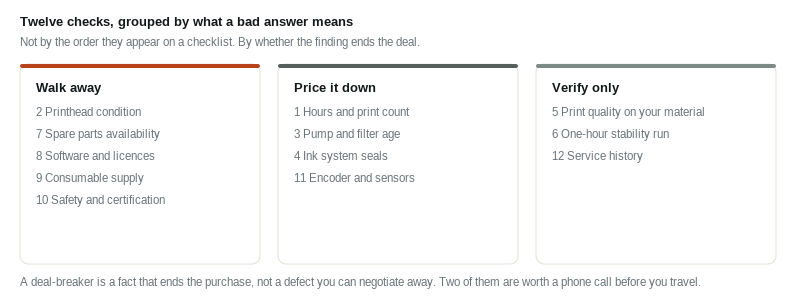
Twenty minutes with a torch and a print test will find most of what matters. Bring your own material.
| # | Check | How | Walk away if |
|---|---|---|---|
| 1 | Hours / print count | Read the service menu, not the seller's word | Hours are implausibly low for the machine's age |
| 2 | Printhead condition | Inspect the nozzle face with a light; run a nozzle test print | Visible scoring, corrosion, or a test print with missing strokes that cleaning does not fix |
| 3 | Pump and filter age | Ask when they were last changed; look at the service log | No record, or overdue by years |
| 4 | Ink system seals | Look for dried ink at joints, crusting under the head | Evidence of long-term leaks — seals and tubing become a project |
| 5 | Print quality on your material | Print at your character height and speed, then rub and wipe | Adhesion fails, or quality falls off within an hour of running |
| 6 | Stability run | One hour continuous at production speed | Needs intervention inside the hour |
| 7 | Spare parts availability | Call a distributor and ask for a printhead and a pump by part number | Either is "no longer available" |
| 8 | Software and licences | Ask whether firmware updates and any licence transfer with the machine | The machine is locked to a licence the seller cannot transfer |
| 9 | Consumable supply | Confirm which ink and solvent families it accepts, and who stocks them | Only one discontinued ink works |
| 10 | Safety and certification | Check the CE/UL plate, guard switches, interlocks | Missing guards, removed interlocks, no nameplate |
| 11 | Encoder and sensor set | Confirm the full set is present and working | Encoder or photo-eye missing — often half the asking price to replace |
| 12 | Service history and provenance | Ask which site it came from and why it was retired | "We don't know" combined with any of the above |
Copy the inspection list
USED CODING MACHINE — 12 POINT CHECK Machine / serial: Hours: 1 Hours / print count ____ 2 Printhead + nozzle test pass / fail 3 Pump + filter age ____ date fitted 4 Ink seals, leaks pass / fail 5 Print on our material pass / fail 6 1 hour stability run pass / fail 7 Printhead + pump available yes / no 8 Firmware + licence transfer yes / no 9 Consumable supply confirmed yes / no 10 Safety plates + interlocks pass / fail 11 Encoder + sensors complete pass / fail 12 Provenance + service log pass / fail Asking price: New price for equivalent: Decision: Notes:
What "refurbished" usually means
The word covers three very different things. Ask which one you are being sold, in writing.
| Term used | What is usually done | What it means for you |
|---|---|---|
| "Used, tested" | Switched on, printed a sample, cleaned externally | Wear items are as old as the machine |
| "Refurbished" | Wear parts replaced, pump and filters renewed, printhead tested or replaced | Meaningful — ask for the parts list and dates |
| "Rebuilt" | Full strip-down, seals and tubing replaced, recalibrated | The closest thing to new; rarely available and rarely cheap |
Price the machine against remaining life, not against the new price. A four-year-old unit with a fresh printhead and full parts availability is worth a large share of new. The same age with a worn head and no pump in stock is worth scrap plus whatever the enclosure weighs.
Four machines to walk away from
- Discontinued with no parts. The first repair that needs a printhead turns the saving into a loss, and the machine becomes furniture.
- Locked to a licence the seller cannot transfer. Some machines will not run without a vendor activation; if that cannot move with the hardware, you own a brick.
- Single-source consumables that are ending. If only one ink family works and it is being discontinued, the machine has a shelf life measured in your remaining stock.
- Sold without a print test. "It was working when it was removed" is not a condition report. No test, no purchase.
Questions we get
How much should a used machine cost relative to new?
It depends almost entirely on parts availability and printhead condition, not on age. A supported model with a good head holds value surprisingly well; an unsupported one is worth little regardless of how clean it looks. Price it as "cost plus one printhead plus one pump", then compare with new.
Is buying from a dealer safer than a factory closing?
A dealer offers a warranty and a relationship, and charges for both. A factory closing offers the lowest price and no recourse. The middle path is a dealer who will put a print test and a parts commitment in writing — that is worth the premium.
Can I move a machine myself?
Physically often yes; practically, laser sources and ink systems do not enjoy transport. Ask for the manufacturer's transport procedure, drain and flush the ink system first, and budget for a commissioning visit. A machine that arrives misaligned costs more than the delivery saved.
What about a used laser versus a used inkjet?
Lasers have fewer wear items and no ink system to revive, so a used laser with a healthy source is often the better second-hand buy. The risk concentrates in the source: ask for its hours and its replacement cost, because a source is the most expensive single part on the machine.
Do I still need an acceptance test?
More than ever. The acceptance sheet applies unchanged, plus the parts-availability and licence checks above. A used machine has no factory acceptance behind it, so the site test is the only evidence you will ever get.
Looking at a specific machine?
Send the model, the asking price and the printhead condition. We will tell you whether the parts are still available and what the machine is realistically worth — before you drive to see it.
Send the model and price