The short answer
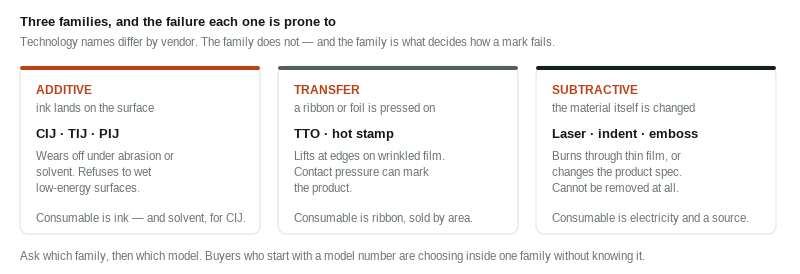
The real dividing line is not speed — it is how the mark attaches. CIJ, TIJ and PIJ add ink; TTO transfers a ribbon; laser changes the material itself. Ink can be rubbed off; a ribbon can lift; a material change cannot. Everything else follows from that one difference.
Why datasheets don't compare
Put five datasheets side by side and you will find five different tests. One quotes speed at 5 mm character height, another at 70 dpi, a third "up to" a number achieved on coated paper in a laboratory. None of them is dishonest; none of them is comparable either.
Three specific ways the numbers mislead:
- Speed and resolution trade against each other. Inkjet throughput is usually quoted at low resolution. Ask what the speed becomes at the resolution you need to read a 2D code.
- Character height changes consumption. Ink use scales roughly with area — doubling character height quadruples the ink per character. A consumption figure is meaningless without a stated height and speed.
- "No consumables" is never true. Laser has no ink, but it has lamps, tubes, sources, filters and extraction. TTO has no ink but has ribbon. CIJ has ink and solvent, and the solvent is often the larger volume.
The only fair comparison
Same substrate, same line speed, same character height, same shift pattern. If a supplier will not restate their figures on those four terms, the data is marketing, not engineering.
Six criteria, five powered methods
This table covers the five methods that use a powered print engine. Mechanical and label-based methods — which still account for a large share of installed capacity — are covered at the end of the page, because they fail in different ways and would distort a table built around ink and energy.
| Criterion | CIJ | TIJ | TTO | Laser | PIJ |
|---|---|---|---|---|---|
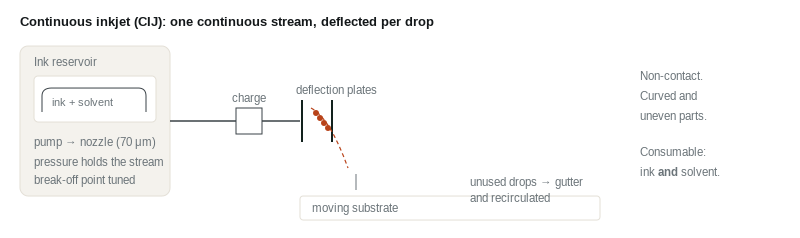
| How the mark attaches | Additive: charged drops deflected onto the surface | Additive: bubble-jet cartridge, drops on demand | Transfer: heat drives wax/resin from ribbon to film | Subtractive: energy changes the material surface | Additive: piezo-driven drops, larger volume |
| Substrates it handles | Nearly all, including curved and uneven; needs the right ink | Porous and coated surfaces; struggles on non-porous film | Flexible film and laminates only | Depends on wavelength; CO₂ for organics, fiber for metal, UV for thin and heat-sensitive | Porous board and cases; large characters |
| Speed | High; non-contact, works on fast lines | High at low resolution, falls steeply as resolution rises | Moderate; limited by ribbon and web handling | High; limited by marking area, not line speed | Moderate |
| Durability of mark | Good with the right ink; solvent resistance varies widely | Fair; can smear on non-porous surfaces | Fair; ribbon can lift or scuff | Permanent — it is in the material | Fair |
| Information density | Multiple lines, small characters possible, 2D codes at reduced speed | High detail; good for small 2D codes and logos | High detail; good for text blocks and codes on film | High detail; 2D codes readable if contrast is adequate | Low; large characters, limited detail |
| Where the money goes | Consumables (ink + solvent), plus maintenance | Cartridges; low capital, high per-unit cost on long runs | Ribbon; predictable, scales with area printed | Capital, electricity, extraction; near-zero per-mark cost | Low consumable cost, low capital |
Typical behaviour across equipment families, not a specification for any model. Within each family, ink chemistry, head count and wavelength move the answer.
Head to head
Comparisons are only useful in pairs, because that is how the decision actually arrives — a buyer is choosing between two shortlisted options, not five.
CIJ vs TIJ
TIJ wins on cartons, labels and coated paper with low to medium volume: cheaper to buy, higher detail, almost no maintenance, and the cartridge swap is something an operator can do without training.
CIJ wins when the surface is curved, the line is fast, the run is long, or the product gets wiped. It is also the only one of the two that handles a range of character heights on the same head.
The trap
TIJ looks cheaper because the machine is cheap. On a long run at high coverage, cartridge cost per thousand marks can exceed CIJ's ink-plus-solvent cost — the crossover usually appears where consumption is high and predictable.
CIJ vs laser
Laser wins where the mark must be permanent, the volume is high, and the material tolerates it: coated board, many plastics, glass, metal. No ink means no solvent handling, no printhead drying, no consumable logistics.
CIJ wins where contrast matters on a dark or variable surface, where the product is heat-sensitive, where the line changes products often, or where the budget cannot absorb the capital outlay. Ink can be white; a laser usually cannot.
TTO vs laser on flexible film
TTO wins on low to medium speed pouch lines where the film cannot tolerate energy: thin laminates, printed areas where a laser would damage the artwork, and any product where the code must sit on top of a coated surface.
Laser wins at higher speed on film that marks well, and where ribbon changes and ribbon stock are a burden. UV laser is the usual choice for thin, heat-sensitive film.
TIJ vs TTO
Both are cheap to enter and both are limited by consumable cost. TIJ handles cartons and labels; TTO handles film. Where a line runs both, this is often the point at which a single technology stops being the answer.
Three cost curves
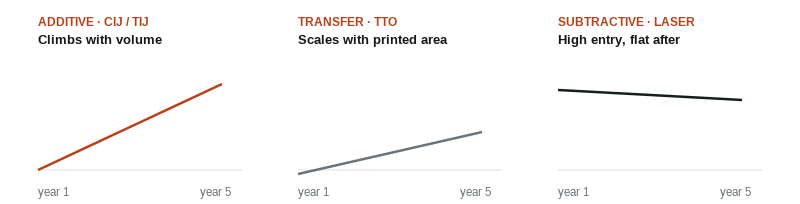
Cost behaviour, not cost figures, is what separates these five. Three shapes cover all of them:
| Shape | Technologies | What it means in year five |
|---|---|---|
| Additive, rising with volume | CIJ, TIJ, PIJ | Cheap to enter, and the total keeps climbing with every mark. At high volume the consumable line overtakes the machine price. |
| Transfer, proportional to area | TTO | Predictable: ribbon cost scales with printed area, so a code-heavy label costs more than a date code. Easy to forecast, hard to reduce. |
| Subtractive, front-loaded | Laser | Expensive to enter, nearly free per mark. The variable that decides the outcome is not ink price but uptime — a laser that stops the line is the most expensive option on the table. |
This is why the ownership comparison in this cluster asks for consumption in millilitres per hour rather than price per litre, and for stops per year rather than MTBF in hours. The curve shape matters more than any single number.
Pick by scenario
| Your situation | First choice | Second | Do not use |
|---|---|---|---|
| Cable or pipe, high speed, curved surface | CIJ (UV-curable ink if wiped) | Laser on suitable compounds | TIJ, TTO |
| Pouch or sachet line, thin laminate | TTO | UV laser on compatible film | CIJ on thin film, indent |
| Cartons, labels, low volume, frequent changes | TIJ | CIJ | Laser (capital), TTO (wrong substrate) |
| Pharma cartons, serialisation, high volume | UV laser | TIJ with solvent ink | Standard CIJ on coated board, TTO |
| Metal parts, tools, permanent ID | Fiber laser | CIJ with metal-compatible ink | TIJ, TTO, PIJ |
| Lowest cost per code, soft film, simple date | Hot stamp | TTO | Laser (cost), CIJ (overkill) |
| Thick insulation or metal, permanent mark, no ink allowed | Indent / emboss | Laser | CIJ, TIJ, TTO |
| Shipping cases, large characters | PIJ | CIJ large character | Laser (cost), TTO (wrong substrate) |
Starting points, not verdicts. The four questions in the selection guide narrow this further using your wall thickness, surface energy, line speed and post-marking exposure.
The methods this comparison leaves out
A comparison that only covers what happens to be in a catalogue is not a comparison, it is a product line. Four other methods are in daily use, and two of them are cheaper than anything in the table above.
| Method | Still chosen when | Why it is not in the main table |
|---|---|---|
| Hot stamp (hot foil) | Flexible film at low to medium speed, lowest possible cost per mark, simple date and lot codes | Contact, dies wear, limited data. Fails on the same criteria but for mechanical reasons, not ink chemistry |
| Indent / emboss wheel | Cable, metal parts, any thick section where a permanent mechanical mark is acceptable | No consumable and no ink at all — cost and failure model do not fit the same table |
| Label applicator | Short runs, frequent artwork changes, markets where a printed label carries the legal text | It applies a printed label rather than creating a mark; buyers compare it against coding, so it belongs in the decision even though it is a different category |
| Screen / pad printing, ink roll | Caps, closures, shaped parts, corrugated cases at very low cost | Usually purchased as part of another process, not as a stand-alone coding decision |
Listed so you can rule them in or out yourself. A buyer who is told "there are five technologies" has been given a shortlist, not a landscape.
Why this section exists
Any comparison is a boundary drawn around what the author had access to. We publish the boundary instead of hiding it, because a table that quietly excludes the cheapest option is a sales document wearing a lab coat.
How each one fails
Every technology has a characteristic failure. Knowing the failure is more useful than knowing the benefit, because the failure is what you will live with on a Tuesday night shift.
| Technology | Signature failure | What it looks like |
|---|---|---|
| CIJ | Printhead drying and nozzle partial clog | Missing characters, ragged edges, gradually weaker print over a shift |
| TIJ | Ink/substrate mismatch | Wet-looking marks that never dry, or smears after handling |
| TTO | Ribbon and web handling | Wrinkles, gaps, codes printed across a fold |
| Laser | Contrast and damage | Marks that read to the eye but fail a scanner; or perforation on thin film |
| PIJ | Resolution ceiling | Characters too coarse for small 2D codes; bleed on absorbent board |
Questions we get
Why is CIJ consumable cost so much higher than TIJ?
Two reasons. CIJ recirculates ink and constantly loses solvent to evaporation, so you buy solvent as well as ink. And CIJ inks are formulated for adhesion on difficult surfaces, which costs more than a cartridge ink designed for paper. The gap narrows at low volume and widens at high coverage.
Can TIJ print on cable?
Rarely well. Cartridge inks are formulated for porous or coated surfaces; on PE and XLPE insulation they bead or smear, and the print is not built to survive coiling. There are industrial TIJ systems with special inks, but at that point you are comparing against CIJ on cost, not convenience.
Will a laser burn through thin film?
It can, which is why wavelength matters more than power on film. UV lasers mark by a cold process and are the usual choice for thin, heat-sensitive materials. CO₂ on thin film is where perforation and edge burn show up first.
Which of the five needs the least maintenance?
TIJ in normal use, because the cartridge is the printhead and it gets replaced. Laser needs little routine attention but has expensive wear items and extraction to maintain. CIJ needs the most routine care — daily and weekly tasks — and that labour is a real cost line, not a footnote.
Can one machine cover two technologies?
No. These are separate physical principles, not settings. What does exist is a hybrid line where two heads of different types are mounted on one gantry — that is two systems sharing a frame, with two sets of consumables and two maintenance routines.
Two technologies, one substrate, no clear winner?
Send the material, character height and line speed. We will tell you which two are worth a trial — and which of the five should be dropped before you spend time on it.
Send the parameters