The short answer
Leasing does not make a machine cheaper; it changes when you pay and what you are allowed to stop paying for. Over five years, buying almost always totals less. Leasing buys three things instead: no capital outlay, a service obligation in writing, and a way out if the product changes.
The question is rarely "which is cheaper". It is "what else am I buying with the difference" — and whether those three things are worth the premium, which on a five-year term is usually between ten and thirty percent of the machine price.
Why the monthly figure lies
Lease quotes are designed to be compared with a monthly budget line, not with another machine. Four things make the quoted rate misleading:
- The term is chosen to hit a monthly number. A sixty-month term looks cheap per month and costs the most in total. Always compare total of payments, not the payment.
- Consumables are often bundled. A rate that includes ink hides a markup you would not pay separately — and it usually carries a minimum volume, which is a purchase obligation in disguise.
- Deposits and end fees sit outside the rate. An advance rental or an end-of-term purchase option can add five to ten percent that never appears in the monthly figure.
- Service is bundled or excluded by a footnote. A lease with a response-time commitment is worth more than one where service is invoiced separately at call-out rates.
One line to add to every lease quote
"Total of all payments over the term, including deposit, end-of-term options and any consumable commitment at minimum volume." Ask for it in writing. It converts a sales conversation into a numbers conversation.
Three ways to get the same machine
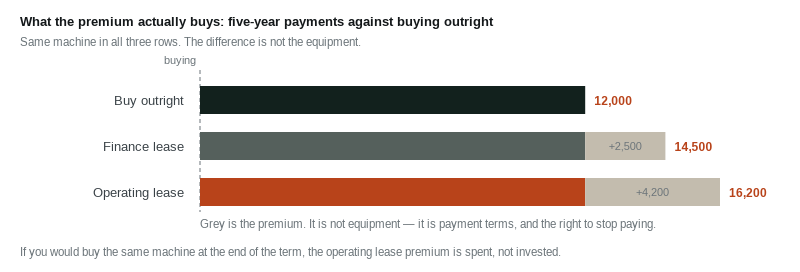
The same unit, three structures. The example below uses an illustrative machine and rate so you can see the shape of the comparison; replace every number with your own quote.
| Structure | Cash out in year 1 | 5-year total | Who owns it after | What you gain |
|---|---|---|---|---|
| Buy outright | 12,000 | 12,000 | You | Lowest total; asset on the books; free to change consumables |
| Finance lease | 2,900 | 14,500 | You, after final payment | Spread cost; ownership retained; usually fixed rate |
| Operating lease | 1,600 | 16,200 | Nobody — return or buy at a set figure | Off balance sheet; service included; exit at term |
Illustrative structures for a machine with a 12,000 cash price. Real rates depend on credit, term and jurisdiction; the ordering of the totals is what usually holds.
Notice what the extra cost buys. The finance lease pays about 2,500 for spreading the payment. The operating lease pays about 4,200 for spreading it and for the right to walk away — which is worth it only if there is a real chance you will want to.
And the machine is one line of seven. Whatever structure you choose, it has to be run through the ownership worksheet, because on a busy line the consumable and downtime lines dwarf the difference between these three quotes.
When leasing is right — and when it is not
| Situation | Better choice | Why |
|---|---|---|
| New product, unproven volume | Operating lease | If the line never reaches volume, a capital purchase is stranded |
| Steady production, 4,000+ hours a year | Buy | Utilisation is high enough that the financing premium buys nothing |
| No maintenance team on site | Operating lease with service | You are buying response time, not just equipment |
| Capital budget already allocated | Buy | Financing adds cost without adding capability |
| Tax treatment favours expensing | Lease | Worth checking with your accountant — it can be the whole argument |
| Two products, uncertain which survives | Short operating lease | Exit beats optimisation when the requirement may change |
Five end-of-term clauses that decide the cost
Almost all of the negotiation that matters happens in the last page, not the first. These five are where leases turn expensive.
01
Purchase option price
If buying out at the end is priced at a nominal figure, the lease is a finance deal in disguise — usually fine. If it is priced at "fair market value", ask who determines that value and on what basis.
02
Minimum consumable volume
A bundled consumable rate usually carries a minimum annual spend. If your production drops, you pay for ink you never use. Get the number and test it against your worst plausible year.
03
Return condition
"Fair wear and tear" is the phrase to interrogate. Ask what refurbishment charge applies per printhead, per cover, per missing accessory. A vague condition clause is a bill you meet at handback.
04
Early termination
What does it cost to end in year two? If the answer is "all remaining payments", the operating lease is not offering you an exit — it is offering you a longer commitment with a nicer name.
05
Consumable price escalation
Annual increases of "up to CPI" and "up to 8%" are different contracts. Over five years the gap between 3% and 8% compounding is roughly a fifth of the consumable spend. Put a cap in.
The test for any lease
Write down the total of payments, the minimum consumable spend, and the exit cost. Add them. If that number is more than the cash price plus your expected maintenance, the lease is buying convenience — which may still be right, but it should be a decision, not a discovery.
Questions we get
Is a lease always more expensive than buying?
In total cash, yes — the lessor is borrowing money on your behalf and charging for it. The exceptions are tax treatment and the value of a genuine exit. Neither is a reason to skip the arithmetic; both are reasons the arithmetic may end in a different place.
What is the difference between a finance lease and an operating lease?
A finance lease transfers ownership at the end for a small or nominal payment, so it behaves like a loan. An operating lease returns the equipment, with an option to buy at a set or market figure. The distinction matters most for accounting treatment and for how expensive early exit becomes.
Should I take the bundled consumables?
Only if the bundled rate is at or below what you would pay separately, at your real consumption. Bundles are priced on an assumed volume — if you run leaner than that assumption, you are paying for ink you never use. Compare against the worksheet.
Can I negotiate the end-of-term price before signing?
Yes, and you should. The purchase option, the return condition and the escalation cap are all negotiable before signature and almost never after. Ask for them as numbers, not as "standard terms".
What if my production volume doubles during the term?
Check whether the agreement allows added capacity at the same rate, and whether the minimum consumable volume scales with it. A lease signed for one line that becomes two is a common source of avoidable cost.
Two quotes, one lease, no clear winner?
Send the total-of-payments, the minimum consumable commitment and the exit cost for each option. We will tell you which number is doing the damage. We do not sell machines and we do not arrange finance.
Send the three numbers