The short answer
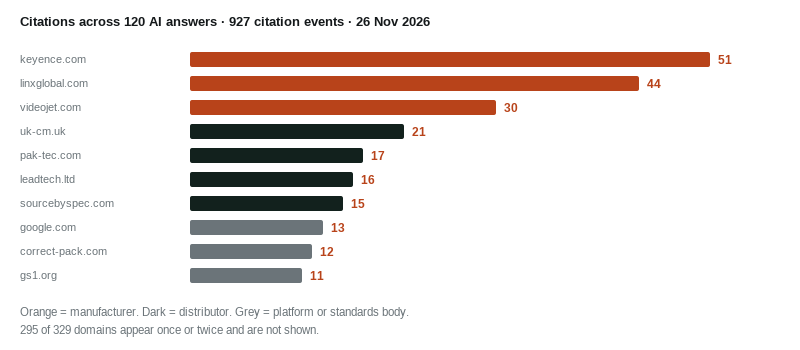
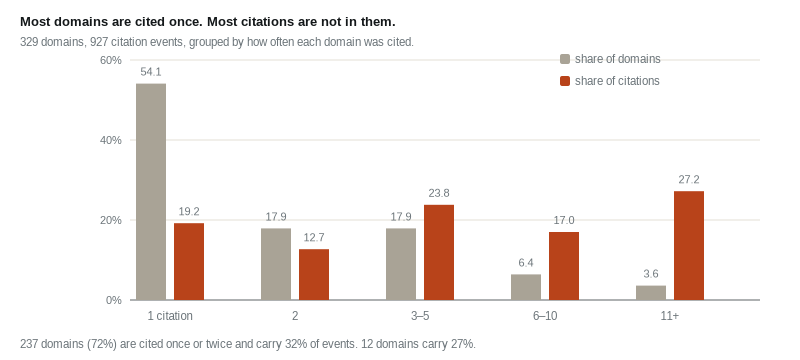
AI search does not cite "the industry" — it cites a small set of explanation pages. Three manufacturers take 13.5% of all citations, and a UK distributor is cited more often than Domino. But 237 of the 329 domains appear only once or twice — and they still carry a third of all citations, which means the field is still open.
Every article on this site says "buyers increasingly ask an AI first". That claim is easy to make and hard to check. So we checked it — in the narrow way that is actually possible: we took 40 questions a buyer would plausibly type, asked three AI search engines each of them, and recorded which URLs came back in the citations.
How we ran it
Questions
40, written as plain buyer queries — no brand names, no prompt engineering
Groups
8 awareness · 8 comparison · 8 application · 8 cost/selection · 4 supplier · 4 fault
Engines
ChatGPT Search, Claude (both with web retrieval forced on), Perplexity — all via the DataForSEO LLM Responses API
Answered on
26 November 2026, single snapshot, 120 calls, zero failures
Collected
927 citation URLs, 329 unique domains, 7.7 citations per answer on average
Cost
about $4 in API calls
Reproducible
yes — the script and the raw JSON are published, see the data
Two choices worth stating, because they change the numbers. We forced web retrieval on for both ChatGPT and Claude: without it, neither cites anything, and you would be measuring brand memory instead of visibility. And we asked in English only — a Chinese-language run would produce a different map, which we have not done yet.
Who gets cited
| Domain | Type | Citations | Perplexity | ChatGPT | Claude |
|---|---|---|---|---|---|
| keyence.com | Manufacturer | 51 | 25 | 12 | 14 |
| linxglobal.com | Manufacturer | 44 | 24 | 10 | 10 |
| videojet.com | Manufacturer | 30 | 11 | 9 | 10 |
| uk-cm.uk | Distributor | 21 | 4 | 2 | 15 |
| pak-tec.com | Distributor | 17 | 3 | 7 | 7 |
| leadtech.ltd | Distributor | 16 | 12 | 3 | 1 |
| sourcebyspec.com | Distributor | 15 | 8 | 1 | 6 |
| google.com | Platform | 13 | 0 | 13 | 0 |
| correct-pack.com | Distributor | 12 | 1 | 0 | 11 |
| gs1.org | Standards body | 11 | 6 | 0 | 5 |
| kingsfang.com | Distributor | 11 | 1 | 6 | 4 |
| youtube.com | Platform | 11 | 0 | 11 | 0 |
| linkedin.com | Platform | 10 | 10 | 0 | 0 |
| meenjet.net | Distributor | 10 | 5 | 5 | 0 |
| bettercode.co.th | Distributor | 10 | 8 | 0 | 2 |
| domino-printing.com | Manufacturer | 8 | 5 | 2 | 1 |
| fda.gov | Regulator | 8 | 3 | 5 | 0 |
| alibaba.com | Marketplace | 8 | 7 | 0 | 1 |
| matthewsmarking.com | Manufacturer | 8 | 5 | 0 | 3 |
Citation events in 120 answers, 26 Nov 2026. A citation is one URL returned in one answer; the same URL cited twice in one answer counts once.
Three observations from that table:
- Three domains absorb 13.5% of all citations. Keyence, Linx and Videojet account for 125 of 927 citation events. If AI search were the only channel, that is the whole visible industry.
- A distributor is in fourth place.
uk-cm.ukgets 21 citations — more than Domino, Matthews or Markem-Imaje. It is not a manufacturer; it is a UK reseller that publishes explanation pages. Claude cites it 15 times, more than any manufacturer. - The long tail is enormous, but it is thin. 237 of the 329 domains (72%) appear once or twice and together carry 32% of all citations. The ten biggest domains take a quarter; the remaining three quarters is spread across 319 sites.
The pattern behind the ranking
The sites that win are not the ones with the biggest product catalogue. They are the ones with pages that answer a question in a form an engine can lift — a comparison table, a "what is X" explainer, a troubleshooting list. Product pages cite poorly; explanation pages cite well.
Each engine eats differently
This is the finding that most changes how you would act on the data. "Optimising for AI" is not one job, because the three engines do not read the same shelf.
| Engine | Signature source | Share | What it means |
|---|---|---|---|
| Perplexity | LinkedIn (10), Alibaba / Made-in-China (15), distributor blogs | 30% of its citations go to platforms and marketplaces | It leans on whatever ranks and reads cleanly, including commercial listings |
| ChatGPT Search | google.com (13), youtube.com (11), medium.com | It cites its own search surface and video | Being on YouTube matters here; a written page alone is not enough |
| Claude | uk-cm.uk (15), correct-pack.com (11), plctalk.net | Specialist and forum sources dominate | It rewards depth and practitioner detail over brand |
Practical reading: the engines differ in how much they reach for. Perplexity cited 400 times across 210 distinct domains — ten links per answer. ChatGPT Search cited 223 times across 100 domains, five and a half per answer, and returned nothing at all on five questions. Claude sat between them at 304 across 111. A small site has more room in Perplexity; for ChatGPT, a video of the same content is part of the answer, not an extra.
Where the door is open
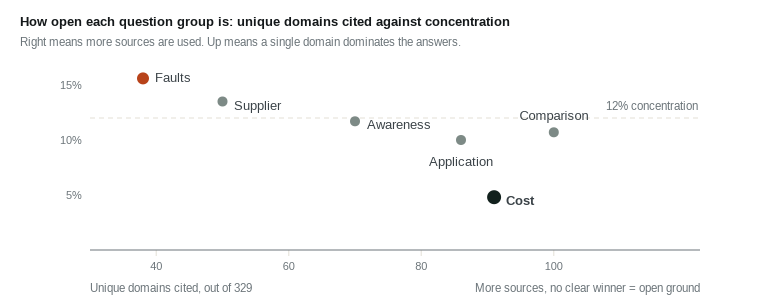
We split the 40 questions into six groups and measured how concentrated the citations were in each. A low concentration means many different sites get cited — a new site can enter. A high concentration means one or two domains own the topic.
| Question group | Answers | Avg citations | Unique domains | Top domain share | Openness |
|---|---|---|---|---|---|
| Cost and selection | 24 | 6.9 | 91 | 4.8% | Wide open |
| Application | 24 | 7.5 | 86 | 10.0% | Open |
| Comparison | 24 | 9.3 | 100 | 10.7% | Contested |
| Awareness ("what is X") | 24 | 7.1 | 70 | 11.7% | Contested |
| Supplier / geography | 12 | 8.0 | 50 | 13.5% | Contested |
| Faults and maintenance | 12 | 7.5 | 38 | 15.6% | Locked |
The cost group is the most fragmented: no domain holds more than 4.8% of citations, and 91 different domains appear across 24 answers. That makes sense — nobody publishes real prices, so every engine scrambles for something to quote. A site that published a defensible cost model would be cited almost immediately.
The fault group is the opposite: one distributor dominates, and only 38 domains appear at all. Troubleshooting is where practitioner depth wins and where a new entrant has to be genuinely more specific to get in.
There is a third number that matters more than any of these: 67 of 120 answers cited no major manufacturer at all. For questions about acceptance testing, consumable contracts, used equipment and supplier selection, the engines reached for distributors, forums and marketplaces instead. That is the entry zone.
Memory is not visibility
We ran the same 40 questions through a model with no web access, as a control. It produced zero citations — and named the same four brands from memory.
| Brand | Named in 120 answers with retrieval | Named in 40 answers without retrieval |
|---|---|---|
| Videojet | 12 | 11 |
| Markem-Imaje | 11 | 11 |
| Linx | 10 | 9 |
| Domino | 9 | 10 |
| Keyence | 8 | 3 |
Keyence is cited 51 times — more than any other domain — but appears in model memory only three times out of forty. That gap is the whole argument for content: being cited is an editorial achievement, not a reputation one. A brand can be barely remembered and still be the answer to every question, because it published the page.
What this means
If you are buying: the answer you get is shaped by about ten domains, most of them vendors or their resellers. Treat a citation as "someone published a page", not "someone verified a claim". This is why every figure on this site carries a source.
If you are publishing in this industry: the map above is the strategy. Cost and selection are open. Faults are locked unless you go deeper than a distributor. Comparison is contested and rewards tables. And the long tail — 237 domains cited once or twice — is proof that engines will reach for a small, specific page over a big brand's homepage.
Limits, stated plainly
- One snapshot. 26 November 2026, English only. Models and indexes change weekly; these numbers will age.
- Three engines, not "AI". Not covered: Google AI Overviews, Copilot, Gemini app, and every Chinese engine. A Chinese run would almost certainly produce a different table.
- API ≠ consumer app. We queried models through an API wrapper with retrieval forced on. The consumer interface may cite more, fewer, or different sources.
- One answer per question per engine. No repetition, so we cannot separate "always cited" from "cited this time".
- Citation is not endorsement. An engine citing a page means it found the text useful, not that the text is correct.
The data
Everything behind this article is published, including the questions and the raw answers, so you can check any number above or run the study again next quarter.
questions.json— the 40 questions, with group labelsai-citations.json— 120 answers, citation URLs, latency, full textai-citations-deepseek.json— the no-retrieval controlkb-ai-scan.py— the script that produced them, about 150 lines
We will re-run this each quarter and publish the change. If you want the next one as it lands, say so here.
Want the same map for your own market?
The method works for any B2B category: pick 40 buyer questions, run them through three engines, count the domains. Send us the category and we will tell you whether the door is open or locked — before you spend a year writing into a wall.
Ask for a category check